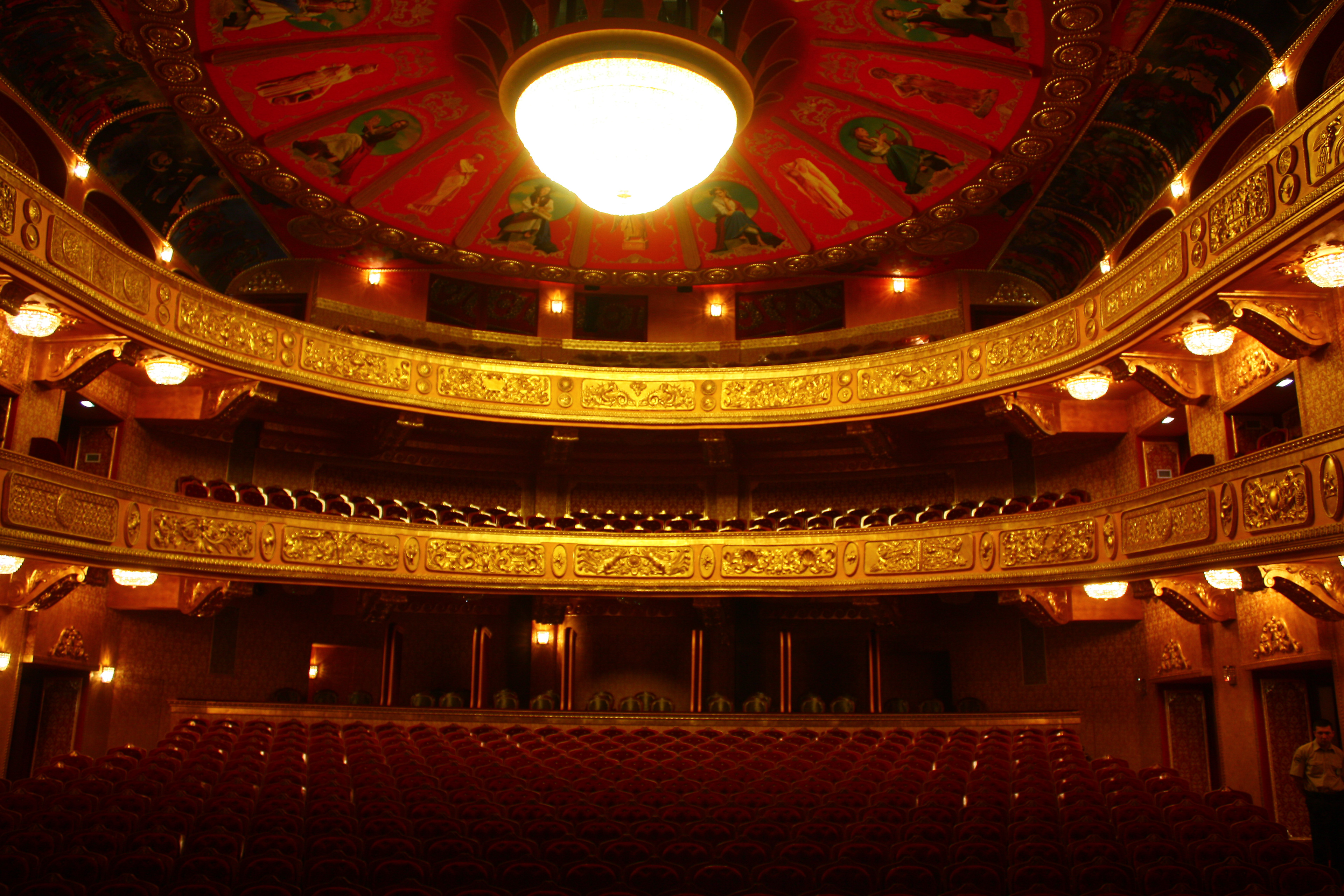
The interior hall of the Macedonian National Theatre.
This illustration was made by Rašo. An email to Rašo would be appreciated too., CC BY-SA 3.0 <https://creativecommons.org/licenses/by-sa/3.0>, via Wikimedia Commons
Title: Interview with Lazaz Apostolov
Author: Dr. Eric Ferreira Crevels
Year: 2025
Type: Audio Transcript
Licence: Open Access
20 March 2025 – Café Shakespear, Skopje, North Macedonia.
EC: Okay, so... I started recording now…you were saying about the groups that worked under you on the gypsum and the gilding.
LA: yes, all the… all the ornamentic [sic] part.
EC: you were in charge of these two?
LZ: Yes, I was officially project manager for a subcontractors company [name of company] and we were subcontracted to Strabag
EC: which it's the Austrian company?
LZ: Yes
EC: So, okay I have a number of questions. These questions are just to open the conversation and you don't need to stick to them exactly, and you can of course refuse to answer any of them as well. I would to start a little bit from the background so, like:
where you come from; what's your profession; how were you trained and how was your career before working for Skopje 2014; and also how did you get involved with this… this project.
LZ: Yes, I was officially project manager for a subcontractors company [name of company] and we were subcontracted to Strabag
EC: which it's the Austrian company?
LZ: Yes
EC: So, okay I have a number of questions. These questions are just to open the conversation and you don't need to stick to them exactly, and you can of course refuse to answer any of them as well. I would to start a little bit from the background so, like:
where you come from; what's your profession; how were you trained and how was your career before working for Skopje 2014; and also how did you get involved with this… this project.
LZ: I was working in company [name of the company redacted]. Company [X] was specialised for the fine arts material market.
I entered this company in 2014 and my education is not connected to conservation, illustration, art or any engineering. I have an education in economics. I have diploma for the business administration which is under the economical group of [?] but, working in this field
for years, I became familiar with this market. I was never included like a expert in the conservation... I was always like a manager, on that side.
So the first project in which we were included in Skopje 2014 -with Strabag– was the Museum of National Struggle for the occupation of Macedonia [Museum of the Macedonian Struggle], where we worked on the framing, because in the museum there are a lot of artistic paintings. They are huge, and we were responsible for framing them, and for their protection. Because protection means… all the paintings come on canvas, in the [?] so we need to stretch them the other frame, make [the] frame, make the protection of the canvas, and install them on the walls. We got this job on the public tender.
EC: this is back in, what, 2000 and…?
LZ: I think... I don't… before... before... I came here, but if I remember well, it is somewhere— I will tell you— the museum was open in 2011... yeah on the eight of September. So it is… I think that the job started on 2010, up to september 2011… so here: it is not a big contract, in relation to the total amount of the cost of this museum. So, total at the end, I think it was less than 60 thousand euros. The second job was this… all this ornamentic [sic] works in the theatre, where we were choosen by Strabag... like a subcontractor.
Also, very important, when I entered the [X] company, selling fine materials… we also do some courses for painting, and we start to work a lot with the conservation... with restoration material and, in time, some of us even made branch offices specialised for this kind of works. In the beginning, I was selling the materials and equipment for conservation of restoration to the National institutions working in this field...
which means Museums or archaeological sites. Because there is only a few archaeological institutes, like, as independent institutions. And we start working a lot in this field — even last year, working in this company, the annual turnover became 50% fine art material selling and framing, and 50% failing of this conservation and restoration equipment, materials.
EC: What kind of materials are these?
Also, very important, when I entered the [X] company, selling fine materials… we also do some courses for painting, and we start to work a lot with the conservation... with restoration material and, in time, some of us even made branch offices specialised for this kind of works. In the beginning, I was selling the materials and equipment for conservation of restoration to the National institutions working in this field...
which means Museums or archaeological sites. Because there is only a few archaeological institutes, like, as independent institutions. And we start working a lot in this field — even last year, working in this company, the annual turnover became 50% fine art material selling and framing, and 50% failing of this conservation and restoration equipment, materials.
EC: What kind of materials are these?
LZ: equipment and materials... it means the materials that restorators that work in the National institutions use for Protection of the artefacts.
EC: Like varnishes?
LZ: ah, it's varnishes, it's…. but not only that. There is special materials made especially for this purpose. We were a official dealer of these... one of the… ah let's say one of the biggest, I think it's the biggest producer of this kind of material. it's [company name] from Italy. We were official dealer and representative for them in Macedonia. We also do three, four workshops, where we bring experts from Italy — from the factory, professors— working on site with all… almost all people working in this industry in Macedonia. It’s a small industry.
We can say that we have, I don’t know, not more than 50 restorers. So we organised a few workshops, and supported them.
And when this opportunity for this job with Strabag came, I think that there was no other company in Macedonia who could offer this with, like, one compact team, you know? You can find a person - or you can find the people who work with gypsum, but there is no other company with enough capacity to organise, to implement this project.
We can say that we have, I don’t know, not more than 50 restorers. So we organised a few workshops, and supported them.
And when this opportunity for this job with Strabag came, I think that there was no other company in Macedonia who could offer this with, like, one compact team, you know? You can find a person - or you can find the people who work with gypsum, but there is no other company with enough capacity to organise, to implement this project.
So, there is there were two possibilities: one, probably Strabag could find people and do the managing of all these works by themselves, or the other possibility, which was to take us as a company. Because it was a huge job, and very difficult job, because.... this job is not technologically very fast forward, everything — but this is a traditional way of working there. You don't… yes there is a new technology; there is a new material; but the the basis is still hand working, no? Manufacturing.
So, we make an agreement with Strabag and we start the preparation. We organised team of gilders— it was our team — and fot the team for gypsum, we take a subcontractor who work under us, and they were responsible for modelling, the… first thing we do: we got a picture, the idea of the design of the theatre. From this picture, we made, in the ratio 1 by 1, the technical drawing, and this technical drawing was approved by the designer and by the responsible people from the ministry. After that, we made the original model from the clay — and this original model from clay, again, was approved by the designer and the responsible people in ministry.
After this, we do the moulds for the Gypsum, and then we have the original model in Gypsum, where we do the fine tuning. After this, when this model was approved, we started to make the mouldings from the rubber, and start reducing the elements and installing.
After that, comes the gilding… where the gilding was, according to the design, needed.
I remember now that we have 13 kilometres of frames and we have, I think, 30,000 different pieces of the ornaments.
EC: and how many people were working on the…?
LZ: maximum, maximum, more than 90 less than 100, in one period.
EC: so, like, between 90 and a hundred.
LZ: Yeah. That was the maximum ,yeah. But, if I need to tell you, we work, we start first… first winter working, first of November, ah… we finished the most of the job, I think that, I don't remember… 31st of May I think that was. Because there were a several different openings ceremonies. I think the 31st of May was the official opening and after that we worked on some small correction in the summer. So, let's say that permanently 70 to 80 people worked continuously these six months.
EC: if I remember correctly, that was… they were working on the underground of the… basement of the…
LZ: Yes, there [at the museum].
EC: can you talk a little bit about this workshop? how it worked and...?
LZ: the first idea was to work in our workshop, but after that…
EC: here in Skopje as well?
LZ: yes, we had two workshops, one for gilders, in the center of the Skopje, and one for gypsum on the Ilinden municipality, which is a suburb of Skopje. But, uh, speaking with Strabag, we decided it would be much more efficient and have less logistical problems if we worked in the theatre, because, in the same place there will be the Gypsum workers... the gilders, and also we don't have to transport... because when you produce this gypsum, they can break through transport. So, it’s much easier. We agreed with Strabag that they would adapt two rooms in the basement of the theatre. The gypsum was in the basement, but gilded was not in the basement, but we… we prepared a workshop there… tables…. heating... because we worked, for most of the time, in the winter.
It was a challenge. It was a challenge, yes. If somebody now asked me: how it's possible to do all these in seven months, I don't know [laughs]. Even Italian experts when they come from the company, they say: 7 months, all of this? Yes.
Ah, the gilders… the gilders, and also the guys who working on installation of the Gypsum ornaments, were sometimes working from 7 in the morning until 8, 10 in the afternoon.
EC: and you were there as well, I imagine.
LZ: yes, I was there all day, and if they continued to work, I was going home and I was coming back with… I don't know… pizza, sweets, you know, to give to the workers. For strength... but also attention, you know.
EC: so that that's important, I believe...
LZ: it's very important. Very important, when you are struggling, but it is also... it was a… it was a challenge in not only, you know, how to produce all this… first of all, this is a technique that is the same as 500 years ago. There is no change. Maybe some materials and everything, but the technique is the same: gypsum… clay… gilding with the brush… gluing… there is no using of modern technologies, there is no machine. Everything is made by hand.
When I…let's say, when I take the best team for the gilding, I took the people from the museums, from the university of art… yes, in Skopje… and they said “oh we have experience”, and they worked some projects for gilding, but they have made, you know, Ikona? [icon / sculpture]...
with gold leaves, and they have iron, a small iron, wood... and all day you work on in one icon of 15, 10cm square. Now you have 13 Kilometres of frames and, as I told you, more than 13,000 pieces, while working on a high altitude sometimes, and not in a room with heating. So, this is a construction site, you know? Not clean, you know?
And also... we must follow some technical conditions. To provide that, or this… all our job will be done well. Because glue does not function well under five Celsius, and we have huge objects on the in the main hall, which is not only question now of the professional approach, it is also a security question, you know? The health of the people, because we have Gypsum objects on the… we say plafon [ceiling]…on the top of the theatre, which weight more than 300 kilograms per object. So, we must secure them.
Also, you must make the… because the gilding was made not with gold leaves— not 24 carats of gold… but an imitation, and this imitation has problems with oxidation. In real gold there is no oxidation, but gold imitation, they have oxidation. So, if the material is not dry enough, there will be oxidation. And we don't have enough time to wait. Every time, every object it's… case by case… there is no identical case.
EC: and how did you solve that?
LZ: we do our research there, we test some of the technologies. Let's say, the big portals, on the main stage. They are very… massive and, for it to fully dry it would be 6, 8 months.... so it’s possible to dry them. Here, it was not possible, so we... we put… we tested. We made some…We bought materials specially for this, but it was not enough, so we do some improvements on the material. We preserve the front layer to protect the gold leaves, not to get in contact with the water from the [unintelligible]. So we do the impregnation of that front layer, and also we put a lot of small pipes in the back side, to dry the objects from the backside.
EC: it’s quite ingenious, actually.
LZ: yes, yes, yes, but we… we must… we do… every day we do some testing, improvements.
And if you go now you can see that our work is there.
EC: was there something that, like, that didn't work? That you had to redo? Was there something that didn't work in these... in these tests?
LZ: yes, yes, yes, yes, several times we find some problems, but we try to find a way to fix them, you know?
One time we realised that all of the finish, the varnish, became matte in a few days. Probably because of the… what we do... because it's a huge job, huge object… and in the construction phase, it's all open. There is no heating; there is no doors; there is no anything.
So, because for us it was very important to have… I will speak closer [EC: I'm just seeing if it's still recording]… we were…ah… these conditions were not good for us. So, together with Strabag —all these things we do together with Strabag— we made a working place for us, much smaller, with Nylon… we made some small rooms.
Let's say, this is the main room: when you enter in the theatre, you have some ornaments here. Here, there are some people sitting here, and also ornaments. And here, there is a second floor. What we did: we made, a nylon and wood construction… of a small room.
So, because for us it was very important to have… I will speak closer [EC: I'm just seeing if it's still recording]… we were…ah… these conditions were not good for us. So, together with Strabag —all these things we do together with Strabag— we made a working place for us, much smaller, with Nylon… we made some small rooms.
Let's say, this is the main room: when you enter in the theatre, you have some ornaments here. Here, there are some people sitting here, and also ornaments. And here, there is a second floor. What we did: we made, a nylon and wood construction… of a small room.
EC: so it's like, kind of a capsule?
LZ: yes, like a capsule. So you can put heating there, all the time, with heating… I buy the small thermometers, with a humidity meter, everything, so I check everything, I put in the diary… the building diary… because on every page, for every day, you have to file for these conditions. So, we put it in, according the our [metre] statement —because we provide a [metre] statement when we started— and work. Tomorrow… these files... So, we moved this small cabin— to provide… to make, in this small cabin, good enough conditions for our methodology.
EC: this is particularly for gypsum, or more for the glue, or the…?
LZ: this is for the glue and gilding, because, for the gypsum, it does not affect it. We needed a heated room… with enough heat for the moulders, because they work with their hand in the masse. Also, for small ornaments we do the gilding in the workshop —so, a big room— but, for big ornaments, the frames were put first [up the wall] and after that the gilding was also [made], on site.
EC: So, you were talking about this little sauna you were making, and about the glue. What kind of glue is this, you know... like, is it like chemical, or is this a specific kind of glue?
LZ: Yes, it's a specific kind of glue. It is. It is specific glue for gilding the... but it's… I am not expert, I'm a manager. But the base is a natural base. It's rabbit skin.
EC: ah, ok, so it’s organic
LZ: organic, okay, yeah, but I don't know. Probably have some small chemical additives.
EC: And I can see from the images [from video of the YouTube channel Academia Restauro, shown in his phone] that the workers are quite young. Do they come from the University?
LZ: Yes, in Skopje.
EC: And how was that relation? Was it easy to work with them? They had to learn a lot?
LZ: They had some experience, but there was no company, and there was no people… with this kind of experience, because there is no object of this kind in the last 100 years in Southeast Europe; because this kind of object was made 500 years ago in Vienna, in Budapest, you know? That was the time when this kind of object was… with this style, was done. Now the objects which are built need a new, modern style. So, there is no experienced company or people working on this.
It was easy for us to find these people, because we work in the field of art, materials, restoration… and this, I told you, we know personally all the people working in this industry. But also, almost all of them are customers in our stores for materials, equipment. They study fine art. There is no university or faculty specialised for restoration [in North Macedonia]. They study fine art, drawing, modelling… and they have exams for restoration techniques.
Also, the state institutions, like a museum, like an archaeological site. When they do, in the summer, some projects for the restoration or conservation — Now. Restoration is when it is damaged, to fix it. Conservation is to protect — when they do some projects, they don't have enough people in the institution. They have two, three conservators in the institution. They took also these students to work for them. But we personally knew all of them, so it was easy for us to take them. It was easy for us because we knew almost… I know them personally. I know their characters, which is also important. But, they learned through the process. We learned here also. I told you, this quantity of gilding and gypsum, according to my research, [was] not [done] in the last 100 years, in Southeast Europe. So…
EC: So, I imagine you have a good relationship [with them].
LZ: Yes, yes, still.
EC: Do you still have contact with them?
LZ: Not with all of them, but some of them. Some of them, before that, were also my friends. And now, after this, some of them… I know… I was only known to them like people. Now I have better relations. Some of them are not working anymore in Macedonia.
EC: I can imagine that was a good opportunity for artists also, to start… especially starting their career.
LZ: Yes, yes.
EC: Do you know if there was a continuation of that afterwards? Or it's just like… they have to move areas…?
LZ: No, they… we have also another, let's say, small project for Skopje village. It was constant in [?] church, yeah, where we did the gilding.
From the point, you take quota, I think 16 metre, up to 21 metre, the marble. All was made from marble, in the outside. It was, according the design, it was not… it is not polished, okay? So it is rough, and there is marble, travertine. There is a hole.
From the point, you take quota, I think 16 metre, up to 21 metre, the marble. All was made from marble, in the outside. It was, according the design, it was not… it is not polished, okay? So it is rough, and there is marble, travertine. There is a hole.
Ah... the idea of the designer was to make the gilding, but... they see some gilding on the internet, the process of building, but building for spoons and not for stones. And they come to us. We tell them how it can be done. They accept our suggestions, and change the method and all the holes.
And still, the church is not ready; it is still under the building phase. Nobody works on it. But still it is under the building process.
From the 16 metre to the 21 metre, on the outside, on the marble in every hole, there is a gold [leaf?], but it is 24 karat gold, because it's outside… and it is original gold. And we… some of the people, let's say 30% from the guilders, work on this project. But it was much, much, much smaller… much smaller in the quantity…
EC: Is there a lot of difference between the real gold and…?
LZ: In the method? No. In the technique, yes, because when you work with the imitation, you don't care about the material, you know? You care about the time. But when you work with the gold, you care about the material. So, you can see, here, with the imitation, you put the whole leaf and just apply it in everything…. it's falling down, falling down. It's like snow, you know? But when you work with original gold, no, you collect this and use it again. Only this is the difference, and you don't need to take care about the protection [of authentic gold] so much, because there is no oxidation.
EC: Great. Can you talk a little bit about how was your daily life during the work on the theatre, for example?
LZ: Same routine, every day… hard, big pressure, because [of the] deadlines. You know, we have… our company, have 1 million euro of bank guarantee, to subcontractors. So it's, uh, it was not 1 million, but it was, maybe, I don't know… I don’t remember… probably up to, probably up to half a million.
But it is a responsibility, a future responsibility. Responsibility to do the schedule fall on the time. Responsibility, for your company, to do the job like it should be… don't lose bank guarantee… don't lose the image of the company. This was to get all the payments on time. So it also depends on the quality of the work, because there is a supervision which, at the end… there is a supervision from the designer, a supervision from main contractor, a and supervision from the official, supervision company from the Ministry of… and also responsible people from the ministry.
So, very short time… it's make a big pressure. This is one challenge.
So, very short time… it's make a big pressure. This is one challenge.
Another challenge is to do like it should be, because of myself, because I'm the project manager, and I like to finish this project successfully.
And last thing, which is very important, was the safety, the protection of the workers, and after that, of the visitor, because it's a public one, because it's… at the end, it is the most important. And, when you are in hurry, when you're struggling with short deadlines, mistakes are made.
People sometime worked.... We usually worked from Monday to Saturday. Sunday… it was only a few Sundays in this period that we worked… only a few Sundays.
But as the opening day was coming [near], we offered the gilders to work after the official work time. Normally, every hour was paid. And for that was... for the ones who like.... but you how you see on the video: most of them were young, without families, and they see this like an opportunity to make money, to earn money, and also to have a party there, you know? Because I also cared to have a party, you know, music… In the beginning, it was strange for Strabag even, and for the safety officers from Strabag especially… but we had an excellent cooperation. I can say, you know, the…
First thing, it was strange to bring 50 young girls in the construction project, you know? For the workers there, it's not an everyday situation, you know?
EC: Was that okay? Or was that…. or did they have problems?
LZ: No, no, we don't have. We don't have problems. In the beginning, you know, there was a lot of workers coming into our workshops, but they don't make problems. They like to be there, you know? And we made the rules with Strabag. Strabag cared about them, you know? It was no problem. Even this… The strange thing was the music in the building [site] and something like this, but, in the end…
EC: And this was, like, along the workday, or only at night?
LZ: in the night was much more, you know, because they were…. in the… they were alone, in the building, and they can…
EC: but also during the day?
LZ: Yes, yes. But also in the days, you know? It gave us a good working environment. For everybody.
EC: Yes, I heard the general conditions of the construction sites were quite good
LZ: yes, yes.
EC: Do you know of other projects? If it was the same in other projects, on other teams, as well?
LZ: I told you, I can tell you that I worked in the museum. There, it was much worse. Yes, because, you know, it was not like in the theatre. I think there were three main contractors [at the museum]: Strabag… More, Morena, something like that…. from Italy. And they were [there] for some, some patent? But don't take this information like 100% right. And there was [inaudible] for the technical equipment on the stage.
But Strabag was the main operator taking care about the project, and there was not one company managing everything, so that there is some rules for everything… In the museum, at the same time, 10 independent company were working and everybody takes care only about them, you know?
And it is… the building there was… not enough clean, not protected accordingly. But we were not… in that building… We were not affected by this, because our job was coming almost at the end. When the interior was almost ready, we were coming in to instal the paintings. So we were not affected. But we… usually, I often went there to take the measurements, to see the place where we needed to hang the paintings, and… I see
EC: You talk a little bit about the safety measures. Can we explain that a bit further?
LZ: Safety measures. Strabag has their own employee, an officer for safety measures. So they... they gave us a safety rule book, and we… they are an Austrian company, and we were obligated to follow... to follow this book.
But I was... personally… the safety officer was very responsible. She was a woman. I don't remember the name [checking the phone], I will see. Responsible woman, taking care really of the responsibility, but without enough understanding of our position there. Because our employees were not workers in the building career. So, not to give them… how to say, not to break down the rules, but… they are artists. You know? The way of thinking of artists is quite libertarian. You know? To feel like that... there... and also, I was thinking: this was a change, and it was also putting me in fear, you know? Because the people don't follow the rules, the artists… they can make mistakes there. Sometimes we work on 15 metres high, you know? On scaffolding. So, you must follow, every day, all the workers… you can see that most of them... all of them, were every day in working equipment.
Sometimes we must take off the helmets, because, you know, when they work like this [leans back representing work laying down], the helmet doesn't have a function, but only then. This is a problem we had. So this is the things that we were handling with this officer of Strabag. Also, I told you, every day, even if they work in the night, every night…. either 15 minutes break… half hour… see if they drink enough water... they don’t care about the break, they're young. They have enough power to work, but need to take a break... to take, you know, when they come back on the scaffolding, on the working platform... to have enough attention to protect themselves.
EC: They were working on their backs?
LZ: Sometimes.
EC: What you also mentioned is that there was, of course, the architects and the designers and the teams of supervisors from the ministries. How was the relationship with these other agents?
LZ: With Strabag, it was excellent. And they never…. Strabag, in the beginning, had some expert [brought in] from Serbia, and this guy was… how to say… a hard character, but this hard character also gave us a lot of support in the beginning, asking us to follow some rules that, in the next period of working, these rules … became a help for us. Because of this, I don't say that this guy was problem for us. In the beginning, it was hard, because he was very strict about… about the rules, but, after that... but, after that, we learned how to work with each other, and, in the end, it was very helpful for us, because this helped us to don't have problems with all other supervisors.
So, the designer… for us, for our team, was no problem. I heard that a lot of other companies has a problem with the main designer—he was also an architect... architect, you know? But we don't have problems.
Strabag gather [inaudible]... The main supervision was [from] the public company for managing apartments and stores for the state. You know? It’s public….
So, in our job, as I told you, nobody has expertise enough and experience before. So, for our job, we know much more than the supervisors. So, you know, when they're coming, they can't… how to say… make some problems. But there is a possibility, this doesn’t… because they don't have expertise, to be… to feel fear and to make problems to protect themselves. No, we didn't have such a situation. So, I can say that it was… from that side, we didn’t have problems.
So, in our job, as I told you, nobody has expertise enough and experience before. So, for our job, we know much more than the supervisors. So, you know, when they're coming, they can't… how to say… make some problems. But there is a possibility, this doesn’t… because they don't have expertise, to be… to feel fear and to make problems to protect themselves. No, we didn't have such a situation. So, I can say that it was… from that side, we didn’t have problems.
We had problems because there was [much] changing in the designs, sometimes on a daily level. Not because of the ornaments, but because of the vision of the designer or… I don't know, some pipeline [that] should pass somewhere, or… I don't know, the fire protection sprinkler system or something like that. And it was changing our work. Sometimes we [had to] move something, or sometimes we needed to take out something, to go… other, behind the wall, to do some improvements, and after that we should bring back our [inaudible] to the place. So
like problems with.... there's a name...
like problems with.... there's a name...
EC: So, it was a problem of… the different kinds of projects that go into a building project.
LZ: Yes, yeah, yeah.
In some normal circumstances, we should come when everything is done. But, you know, if you have three years to make the theatre, yes, but… even now, one time, I suggested to the people of the ministry: don't make us funny. Some of the things you want we can do after the opening of the theatre, it will be a show, you know? Because our job, at the end... gilding is clean. The installation of the ornaments, no. But gilding is clean. So, also it's an attraction, because... it was an idea in the beginning of [the museum's] functioning… you know? There is a museum and the theatre… so people can come in the day and see the museum. But also, it was to be an attraction: to see gilders work with small gold leaf, small brushes… and you can… but… So, I tell: don't force us. It was not accepted. But at the end, we finished all our duties, even with the changes in the design, with some improvements and something like this.
In some normal circumstances, we should come when everything is done. But, you know, if you have three years to make the theatre, yes, but… even now, one time, I suggested to the people of the ministry: don't make us funny. Some of the things you want we can do after the opening of the theatre, it will be a show, you know? Because our job, at the end... gilding is clean. The installation of the ornaments, no. But gilding is clean. So, also it's an attraction, because... it was an idea in the beginning of [the museum's] functioning… you know? There is a museum and the theatre… so people can come in the day and see the museum. But also, it was to be an attraction: to see gilders work with small gold leaf, small brushes… and you can… but… So, I tell: don't force us. It was not accepted. But at the end, we finished all our duties, even with the changes in the design, with some improvements and something like this.
So, one thing that I'm sorry about it is that, I told you, the ministry, the responsible people for the theatre, of the ministry, because… and I told them: “please, because you will have some employees on the theatre here, employees for decoration, for technical, one or two of these people, let them work with us [during] the last month… to learn how to do it. And, after that, because gypsum is not hard material, if it is suffering,… from mechanical breaking or something, it will be very easy... if there is small part missing—of some ornament— they can immediately, in 30 minutes, fix it, the gypsum and, after three days, make the gilding.
I think it was a lot of pressure, because of the deadlines and everything, for everybody… also for them. And it was the last thing that the manager of the theatre was thinking about in that period.
EC: So, they didn’t do it.
LZ: They didn't do it.
EC: Do you know of any problems of maintenance afterwards? Did they have…?
LZ: I was visiting the theatre. I am disappointed how it looks now… Not our part of the job, but it is leaking water, after the rain, everywhere. So there are destroyed parts. You visited, probably?
EC: yeah. And I also heard of the leaking,
LZ: Yes. And it's looking terrible.
Our part is looking very good, after 10 years. More than 10 years, because, the theatre was opened, I think, in 2012... in May. So, it is almost 13 years. Our work? excellent. Excellent. It should be... must.... I told you the [metre] statement that every five years they must do some
restoration. Now it will became 15 years.
EC: do you know if they do it?
LZ: No.
So, we are speaking about leaking of water, not ornaments, protection, for restoration, but they…
So, we are speaking about leaking of water, not ornaments, protection, for restoration, but they…
EC: if they don’t fix the water, they won’t fix the ornaments, I suppose. Well, so.... like... moving on a little bit to the relationships after the projects… like, how did participating in that project affected your career?
LZ: Ah. Before that, I like to mention one thing about working there.
The problem was, as I told you, the changing of the design on a daily level, and… from a lot of, how to say? Unresponsible person for that. No? That is the main design. He had some idea, good or bad? No, that can be my subjective opinion, but he is the main designer. He is the chosen one. He gave his idea. It was accepted, and our job was to do all the things according to that idea. But now when you are working somewhere and when you see that there is money invested in some part, and somebody come and decides… “no, okay, it will be very good if we change the purpose of this room for this” and then calls you and change the purpose. We lose time, to do some work for that.
The problem was, as I told you, the changing of the design on a daily level, and… from a lot of, how to say? Unresponsible person for that. No? That is the main design. He had some idea, good or bad? No, that can be my subjective opinion, but he is the main designer. He is the chosen one. He gave his idea. It was accepted, and our job was to do all the things according to that idea. But now when you are working somewhere and when you see that there is money invested in some part, and somebody come and decides… “no, okay, it will be very good if we change the purpose of this room for this” and then calls you and change the purpose. We lose time, to do some work for that.
The state pays some money. For us, the company, okay, it's good. We will move our ornament somewhere [else], somebody will pay… it will be a struggle on how to take money for it, but at the end, you will make an agreement. But it's stupid to change, on a daily level... come some political figure and say 'this will be changing. This, changing.'
This was…I have this example in theatre. I have this example in the museum and I think that it's… I know that everything, the design is… something that always, in the phase of construction, needs to be improved, changed. But I think that, it can be... it's not good to make big changes. Such a big change, in purpose of some room space, or something like that, in the finishing phase...
EC: Well, of course, there was a lot of political talk of the project, as well. And it still is quite political. The whole Skopje 2014 is quite a political story… How do you see that?
LZ: Yes.
This thing that I was saying, there is a political side… there is a political story about it. But it is something for the public. Is it necessary or not? The need is okay or not okay? I can speak about it in my subjective opinion. Now, the problem... the problem with what I noticed before was professional. You know, you have the designer, which is a professional. And he was chosen, so it's not good for some to come… not educated, not authorised, but maybe high level position politician and change the design, no? It's a professional question. It's a professional question, which, at the end, rises the expenses... the cost of the project. But, the most important for me is the professional question.
Yes, it's political. It was very political, with a political influenced project, and I can speak about my opinion.
My personal opinion about the project… it was not black and white. I can’t say [that] this is bad or good, but [it’s] too expensive… not planned enough, because even… in too much political pressure for deadline, for finishing, you know? It became… it became even not only a political issue… I can say I worked on… I have some small works on East Gate [the shopping mall] and there is no political picture. But also now, it became now normal to the managers to take the role of the key players, and they like to show [off] in front of the investigators who put them on this position “yeah, we will… make all the deadline shorter”. But, at the end, it has a price.
My personal opinion about the project… it was not black and white. I can’t say [that] this is bad or good, but [it’s] too expensive… not planned enough, because even… in too much political pressure for deadline, for finishing, you know? It became… it became even not only a political issue… I can say I worked on… I have some small works on East Gate [the shopping mall] and there is no political picture. But also now, it became now normal to the managers to take the role of the key players, and they like to show [off] in front of the investigators who put them on this position “yeah, we will… make all the deadline shorter”. But, at the end, it has a price.
EC: and you say that price is…
LZ: The price is quality. There is no quality… or new expenses. This is in the good scenario; the bad scenario, the price is: somebody dies.
EC: Do you know if accidents happened a lot in other projects?
LZ: In the Skopje 2014, I don't know. Where I worked, … I don't… there were a small injuries, but nothing serious happened. Nothing serious. I don't remember that for other projects. For our project, I remember because I was included.
EC: do you think that working in this project affected your career afterwards?
LZ: for sure, for sure. It's a good experience. It is big pressure. It is a big challenge.
Specific approach, you know? This: testing, improving, finding a way how to solve technical problems. Yeah, it gives you a lot of things to learn. Even… also a complex project, to have five different supervisors… and you struggle with deadlines, struggle with political will, struggle with everything. It's a good school.
After, for me… after finishing this hard project, I decide go out of this. I don’t not remember this industry like, like a bad industry. I remember this industry like a very interesting to work, work with artists. No… I remember, no… like, a good industry for work, but it became too much pressure for me. I like to rest and also, probably, I feel that… I reached some level and now there is, after the Theatre, in the building restoration, there is no bigger product than this. So I decided to change something, and I… with one year after, I resigned from this company and changed the industry.
Specific approach, you know? This: testing, improving, finding a way how to solve technical problems. Yeah, it gives you a lot of things to learn. Even… also a complex project, to have five different supervisors… and you struggle with deadlines, struggle with political will, struggle with everything. It's a good school.
After, for me… after finishing this hard project, I decide go out of this. I don’t not remember this industry like, like a bad industry. I remember this industry like a very interesting to work, work with artists. No… I remember, no… like, a good industry for work, but it became too much pressure for me. I like to rest and also, probably, I feel that… I reached some level and now there is, after the Theatre, in the building restoration, there is no bigger product than this. So I decided to change something, and I… with one year after, I resigned from this company and changed the industry.
EC: So you change for…? What do you change to?
LZ: Ha! For the same ownership structure. I decided to rest.... healthier, but in the same ownership structure: “Okay, rest and come to another company”, and I go in the Geological Survey. I was a manager of a company for geology. After that, I was manager in the company in the mechanic industry, and [now] I am an independent consultant in the energy sector.
EC: Okay, there's a lot of different things.
LZ: Yes
EC: nice, yeah, I think that's it, actually. You told me a lot. Thank you very much.